Moroccan Bath vs Turkish Bath: Differences, Steps and Who Each Suits
What is the difference between a Moroccan bath and a Turkish bath? Products, heat and the steps of each session, what a bath really does for your skin, who should ask a doctor first, and how to prepare and choose a spa in Muscat.
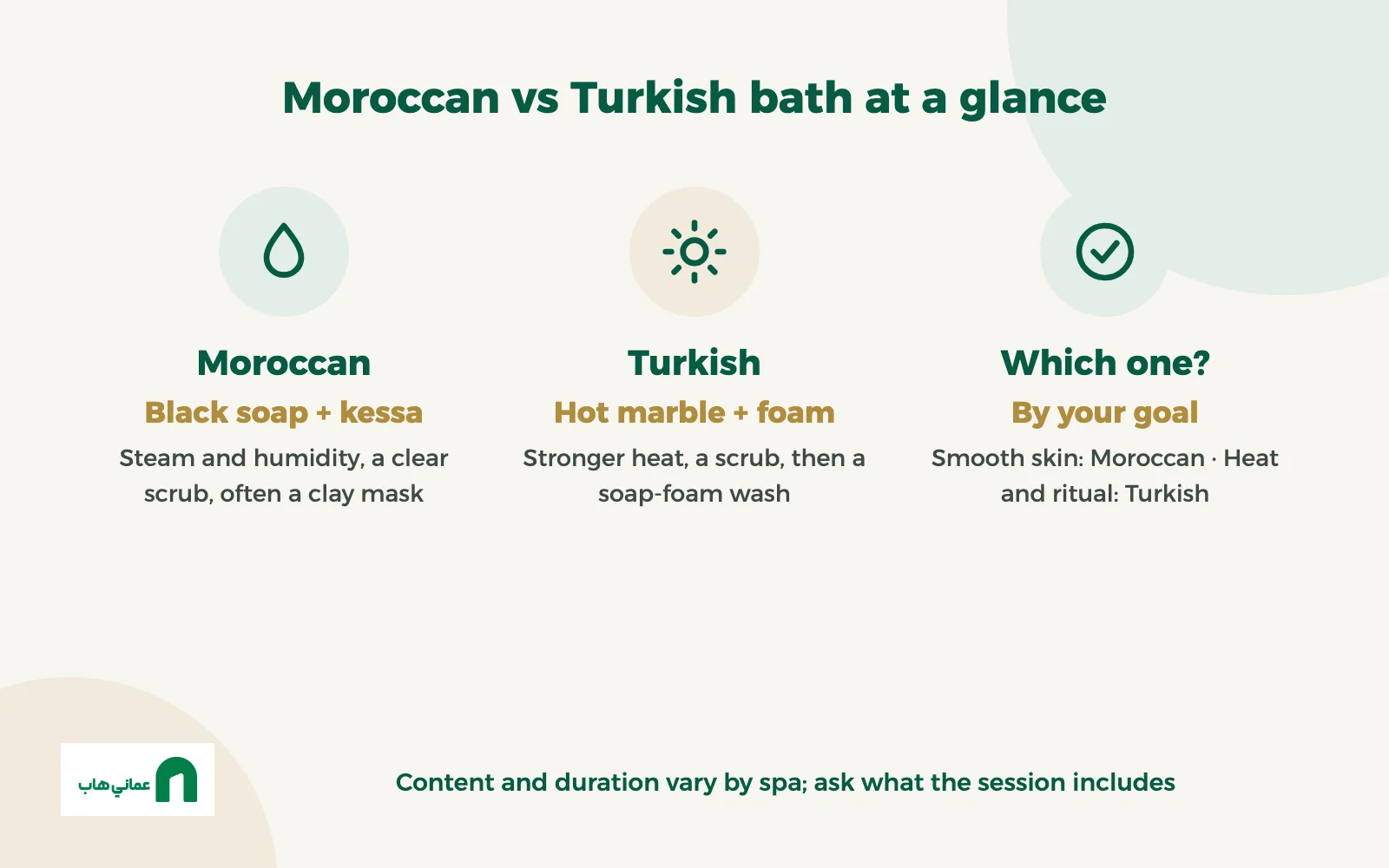
Short answer: A Moroccan bath and a Turkish bath are both steam, cleansing and exfoliation rituals, but they differ in tools and feel. A Moroccan bath usually uses black soap made from olives, then a scrub with a coarse mitt (the kessa) and often a clay mask, in warm, humid air. A Turkish bath centres on heat: you sit or lie on warm marble, then get scrubbed and washed with soap foam. Choose Moroccan if you want a clear exfoliation and smooth skin, and Turkish if you enjoy heat and the full ritual. If you have a heart condition, uncontrolled blood pressure, are pregnant or have sensitive skin, ask a doctor first.
Note: This guide is for general information and consultation preparation, not a diagnosis or treatment advice. OmaniHub is a directory for exploring providers; it does not provide treatment or decide whether a medical procedure suits you.
“Moroccan bath or Turkish bath?” is a question almost everyone asks before booking their first session at a spa in Muscat. Both names appear on the same menus, and many spas describe them with similar words: steam, soap, scrub, relaxation. In practice the two sessions are not the same, and the difference matters if your skin is sensitive or you do not handle heat well.
This guide explains where each one comes from, the difference in a clear table, what happens in each session step by step, what a bath really does for your skin and what it does not, who should ask a doctor before booking, how to prepare and look after your skin afterwards, and which questions to ask a spa before you book. We do not list prices because they vary between spas and change over time; you can compare spas on our Moroccan bath in Muscat and Turkish bath in Muscat pages.
Quick links
- What are the Moroccan bath and the Turkish bath?
- Moroccan vs Turkish bath: the differences in one table
- What happens in a Moroccan bath, step by step?
- What happens in a Turkish bath?
- What a bath really does for your skin, and what it does not
- Who should be careful or ask a doctor first?
- How to prepare, and what to do afterwards
- Which one should you choose?
- How to choose a Moroccan or Turkish bath spa in Muscat
What are the Moroccan bath and the Turkish bath?
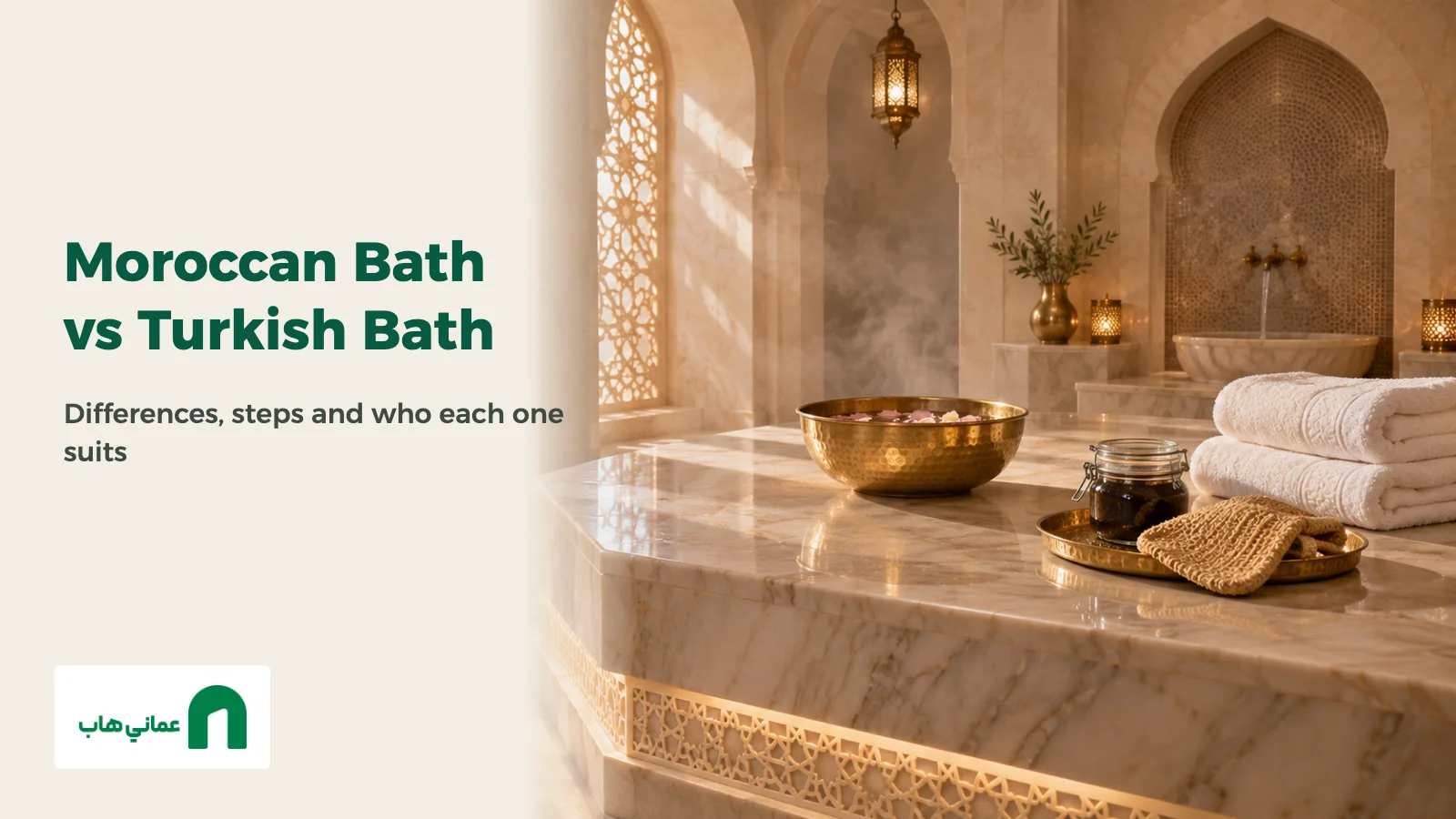
The word “hammam” is Arabic for a bath or bathhouse, from a root linked to heat. The traditional hammam is a public bathhouse known across the Islamic world since around the Umayyad period, and it inherited its idea from Roman baths: a sequence of rooms starting with a changing room, then a cold room, a warm room and a hot, steamy room. People washed with running water rather than soaking in standing water, and women had separate hours or separate facilities.
What Western visitors call a “Turkish bath” is essentially this same hammam as it spread through Ottoman lands. The “Moroccan bath” is the hammam tradition of Morocco, known for its own tools: black soap (beldi soap) made from olive oil and macerated olives, and a coarse mitt called the kessa that removes dead skin once steam and soap have softened it.
In modern spas in Muscat and elsewhere, the hammam is usually no longer a large public hall but a treatment in a private marble or stone room, carried out by a therapist of the same sex as the client. That is why the content of a session varies from spa to spa, and the most important step is to ask exactly what the session includes before you book.
Moroccan vs Turkish bath: the differences in one table
The table below sums up the difference as most spas present it. It is a general picture; some spas blend the two styles or add extra steps.
| Point | Moroccan bath | Turkish bath |
|---|---|---|
| Origin | The hammam tradition of Morocco | The hammam as it spread through Ottoman lands |
| Key product | Black (beldi) soap made from olives | Ordinary soap whipped into a thick foam |
| Scrubbing tool | Coarse kessa mitt | Usually a coarse mitt (kese) |
| Atmosphere | Steam, humidity and warmth | Stronger heat and warm marble to sit or lie on |
| Common extras | Clay mask (such as ghassoul) or rose water | Foam wash, sometimes a short massage |
| Overall feel | Clear exfoliation and noticeably smooth skin | Heat ritual and relaxation with cleansing |
| Best for | People who want exfoliation and smoothness | People who enjoy heat and the full ritual |
Duration, content and price vary by spa; ask what the session includes.
What happens in a Moroccan bath, step by step?
Details vary by spa, but a Moroccan bath session usually follows this order:
- Welcome and preparation: you are usually asked about your health and skin sensitivity, then you change and receive a towel or disposable bathing wear.
- Steam and warming: you sit in a warm, humid room or warm water is poured over you for a few minutes so the outer layer of skin softens.
- Black soap: the body is covered in beldi soap and left for a few minutes; traditional descriptions mention leaving it for 5 to 10 minutes before scrubbing.
- Kessa scrub: the therapist scrubs the body with the coarse kessa mitt and dead skin rolls off in small strands. This is the core step of a Moroccan bath.
- Clay mask: many spas add a clay mask, such as ghassoul, on the body or hair, then rinse it off.
- Rinse and moisturise: the body is rinsed with lukewarm water and a moisturiser or oil is applied; you may be offered water or tea in the relaxation area.
If your skin is sensitive, ask the therapist to use lighter pressure, and do not hesitate to stop them if you feel burning or pain. A good scrub should not leave your skin raw or inflamed.
What happens in a Turkish bath?
A Turkish bath at a spa puts more weight on heat and ritual. The usual order is:
- Warming on hot marble: you sit or lie on a warm marble platform in a hot room until you begin to sweat and the skin softens.
- Mitt scrub: the therapist scrubs the body with a coarse mitt to remove dead skin, usually without black soap.
- Foam wash: soap is whipped inside a cloth bag into a thick foam that is spread over the body and massaged in gently.
- Rinse and rest: the body is rinsed with warm and then lukewarm water, and you rest and drink water before leaving.
Some spas sell a “Turkish bath” that is really a steam session followed by a scrub, and some add a short massage. If you also want a massage, read our guide to massage types and ask whether the massage is included in the time or booked separately.
What a bath really does for your skin, and what it does not
The clearest, most direct benefit of a Moroccan or Turkish bath is exfoliation: removing dead cells from the outer layer of the skin so it feels smoother afterwards. The American Academy of Dermatology divides exfoliation into two types: mechanical, with a tool or scrub (which is what the kessa is), and chemical, with acids such as alpha and beta hydroxy acids. It warns that exfoliation is not for everyone, and that done wrongly it can do more harm than good.
Research on the heat itself is mostly about dry saunas. A systematic review published in 2018 pooled 40 studies with 3,855 participants and found that regular sauna bathing may have health benefits, but only 13 of the studies were randomised controlled trials, most were small, and the authors called for more research. Cleveland Clinic notes that saunas may help with relaxation and sore muscles, and that there is no clear evidence that moist heat is better than dry heat or the other way round.
Some popular claims are not supported by the evidence:
- “A bath makes you lose weight”: the weight you lose after a session is water lost through sweat, and it returns once you drink. Cleveland Clinic says this is not weight loss but dehydration.
- “A bath detoxes the body”: the liver and kidneys clear waste from the body, not sweat, and there is no strong evidence that a bath “draws out toxins”.
- “A bath treats acne or melasma”: a bath is cleansing and exfoliation, not medical treatment, and hard scrubbing can worsen pigmentation for some people. For these concerns see acne treatment or a dermatologist.
Who should be careful or ask a doctor first?
Heat raises skin temperature and heart rate quickly. Harvard Health notes that in a dry sauna skin temperature reaches about 40°C within minutes and the pulse can rise by 30% or more. That is why medical sources advise certain groups to take care:
- Anyone who has recently had a heart attack or stroke: Cleveland Clinic advises avoiding the heat.
- People with heart disease or uncontrolled high or low blood pressure: ask your doctor first.
- Pregnant women or those trying to conceive: ask your doctor before high heat or long sessions.
- Adults over 65 and children under 16, people with epilepsy, and anyone taking medicines that affect sweating or blood pressure.
- Anyone who has been drinking alcohol, or who is ill or feverish on the day: postpone the bath.
- People with sensitive skin, eczema or active psoriasis, and those using retinoid or benzoyl peroxide creams: scrubbing may irritate the skin.
- Anyone with an open wound or sunburn: the AAD says never exfoliate over cuts or sunburned skin.
Watch for signs of heat exhaustion during the session: dizziness, headache, nausea, cramps, intense thirst, and heavy sweating with pale, clammy skin. If they appear, move somewhere cool and drink water. The NHS treats heatstroke as an emergency if you are still unwell after 30 minutes of cooling, or if there is confusion, hot skin that is not sweating, or loss of consciousness.
How to prepare, and what to do afterwards
Before the session:
- Drink plenty of water beforehand, and do not go on a very full or completely empty stomach.
- Do not shave or wax on the same day or the day before; scrubbing freshly shaved skin can irritate it.
- Pause strong chemical exfoliants a few days before if you use them, and ask a dermatologist if you use a prescription retinoid.
- Tell the therapist about any allergy to oils, fragrance or clay, and about any health condition.
- If it is your first time, ask for moderate heat and light scrubbing pressure.
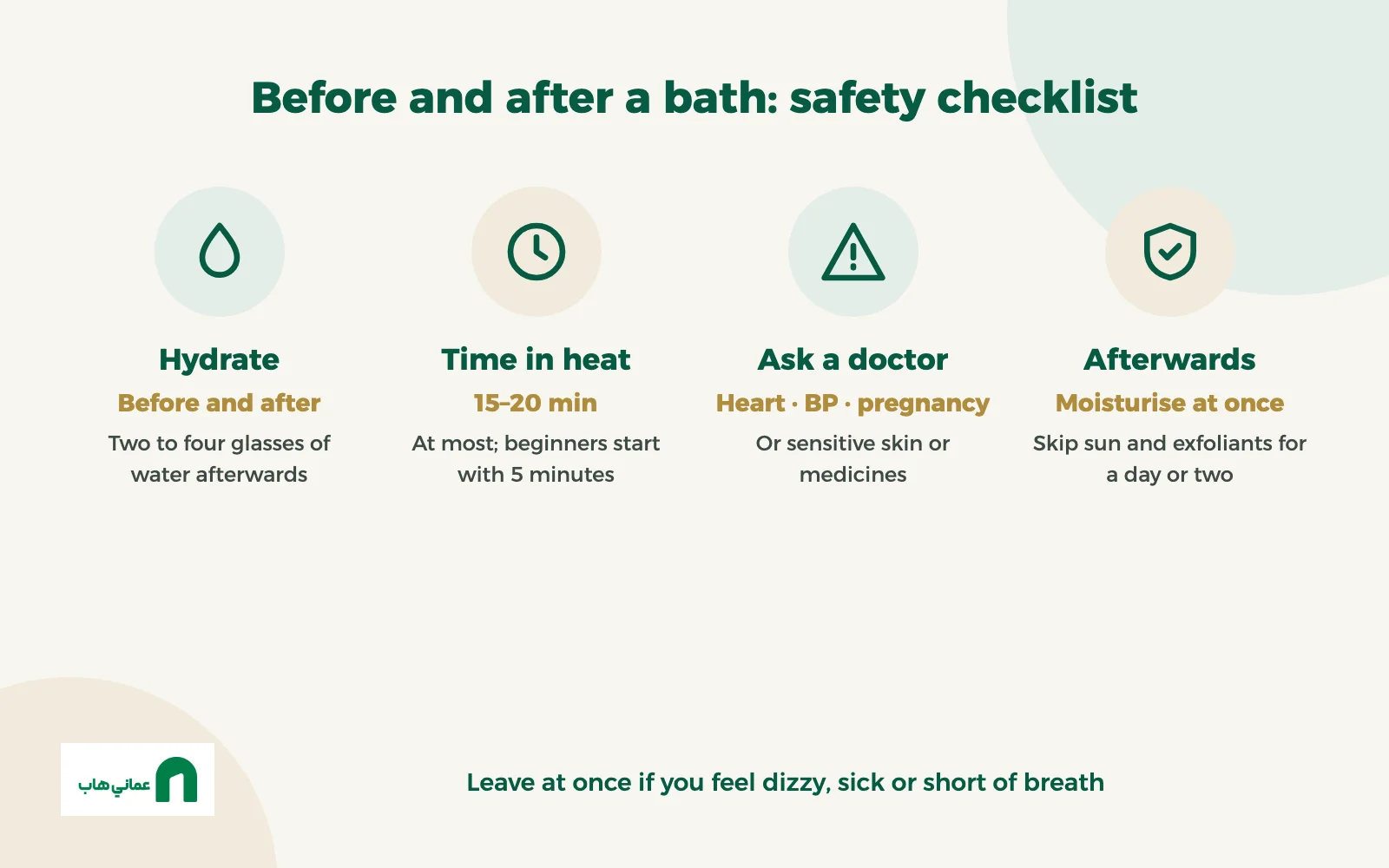
During the session: Harvard Health advises staying in the heat for no more than 15 to 20 minutes at a time, and Cleveland Clinic suggests that beginners start with about 5 minutes and build up. Leave at once if you feel dizzy or short of breath.
After the session:
- Drink water; Harvard Health suggests two to four glasses of cool water after a session, and cool down gradually.
- Apply moisturiser to the body straight away; exfoliation dries the skin, and the AAD recommends moisturising right after exfoliating.
- Avoid direct sun and other exfoliants for a day or two, and use sunscreen on exposed areas.
- Do not repeat the bath too often; strong exfoliation needs longer gaps between sessions, and overdoing it causes redness and irritation. Ask the therapist or a dermatologist about the right interval for your skin.
Which one should you choose?
There is no option that is “best” for everyone. Choose by your goal and what you can tolerate:
| If your goal or situation is… | Usually the better fit |
|---|---|
| You want a clear exfoliation and smooth skin before an occasion | Moroccan bath |
| You enjoy heat, the full ritual and relaxation | Turkish bath |
| Your skin is sensitive or darker and marks easily after irritation | A light-scrub session, or ask a dermatologist first |
| You do not tolerate high heat | A Moroccan bath at moderate heat and shorter time |
| You want a massage as well | Ask about a package that combines bath and massage |
This is a general guide; your health and skin decide what suits you.
The AAD warns that aggressive exfoliation can increase dark spots in people with darker skin tones or those who get marks after spots or burns. If that is you, ask for very light scrubbing or stick to steam and cleansing. You can also read more about body scrubs and the steam room.
How to choose a Moroccan or Turkish bath spa in Muscat
Before booking, ask the spa these questions; the answers tell you a lot about quality and hygiene:
- Is the session in a private room, and is the therapist the same sex as the client?
- What exactly is included: steam, black soap, kessa, clay mask, hair wash, massage? How long does it last?
- Are the mitt, towels and bathing wear new or sanitised for each client?
- Which products are used, and can they be swapped if you have an allergy?
- Do they ask about your health before the session? A good spa does.
- Can the heat or scrub pressure be reduced on request?
- What is the cancellation and late-arrival policy?
Read reviews with a critical eye, and focus on comments about cleanliness, privacy and how clients are treated, not just the photos. If you are unsure whether you need a salon, a spa or a clinic, read Salon, spa or aesthetic clinic: how to choose.
On OmaniHub you can browse Moroccan bath and Turkish bath providers and spa and body care centres in Muscat, compare what each one offers and contact them directly.
Frequently asked questions
What is the main difference between a Moroccan and a Turkish bath?
A Moroccan bath relies on beldi black soap, a kessa mitt scrub and often a clay mask; a Turkish bath relies on heat and warm marble, then a scrub and a soap-foam wash. Both cleanse and exfoliate; they differ in tools, feel and how hot it gets.
How long does a Moroccan bath session take?
It depends on the spa and what is included. The key is not to stay in the heat for more than 15 to 20 minutes at a time, and to rest and drink water between stages. Ask the spa for the full duration before booking.
How often can I have a Moroccan bath?
There is no single number for everyone. Strong exfoliation needs longer gaps between sessions, and overdoing it causes redness and irritation. Start with sessions spaced well apart, watch how your skin reacts, and ask a dermatologist if your skin is sensitive.
Does a Moroccan bath lighten the skin?
No. It removes dead skin so the skin looks smoother and brighter for a while, but it does not change your skin colour. Hard scrubbing can worsen dark spots for some people.
Can I have a Moroccan or Turkish bath while pregnant?
High heat and long sessions call for caution in pregnancy, and Cleveland Clinic advises pregnant women to check with their healthcare provider before using a sauna. Ask your doctor before booking and tell the spa you are pregnant.
Does a bath help you lose weight?
No. What you lose after a session is water from sweating, which returns once you drink. It is not fat.
Should I shave or wax before a Moroccan bath?
It is better not to shave or wax on the day of the session or the day before, because scrubbing freshly shaved skin can cause irritation.
Sources and review
- Wikipedia: Hammam (history, room sequence and bathing routine)
- Wikipedia: Moroccan black soap (beldi) and the kessa
- American Academy of Dermatology (AAD): How to safely exfoliate
- Cleveland Clinic: Sauna benefits, risks and who should ask a doctor first
- Harvard Health: Saunas and your health, with safety precautions
- NHS: Heat exhaustion and heatstroke
- Hussain and Cohen (2018): Systematic review of regular dry sauna bathing
Sources reviewed on 22 November 2026. Information is general and does not predict any individual case.