Laser Clinic Near Me: A Safety Checklist Before You Book (Licence, Device, Patch Test)
Before booking the nearest laser clinic in Muscat: how to check the clinic and practitioner licence, what to ask about the device, why a patch test matters, and safety and warning signs.
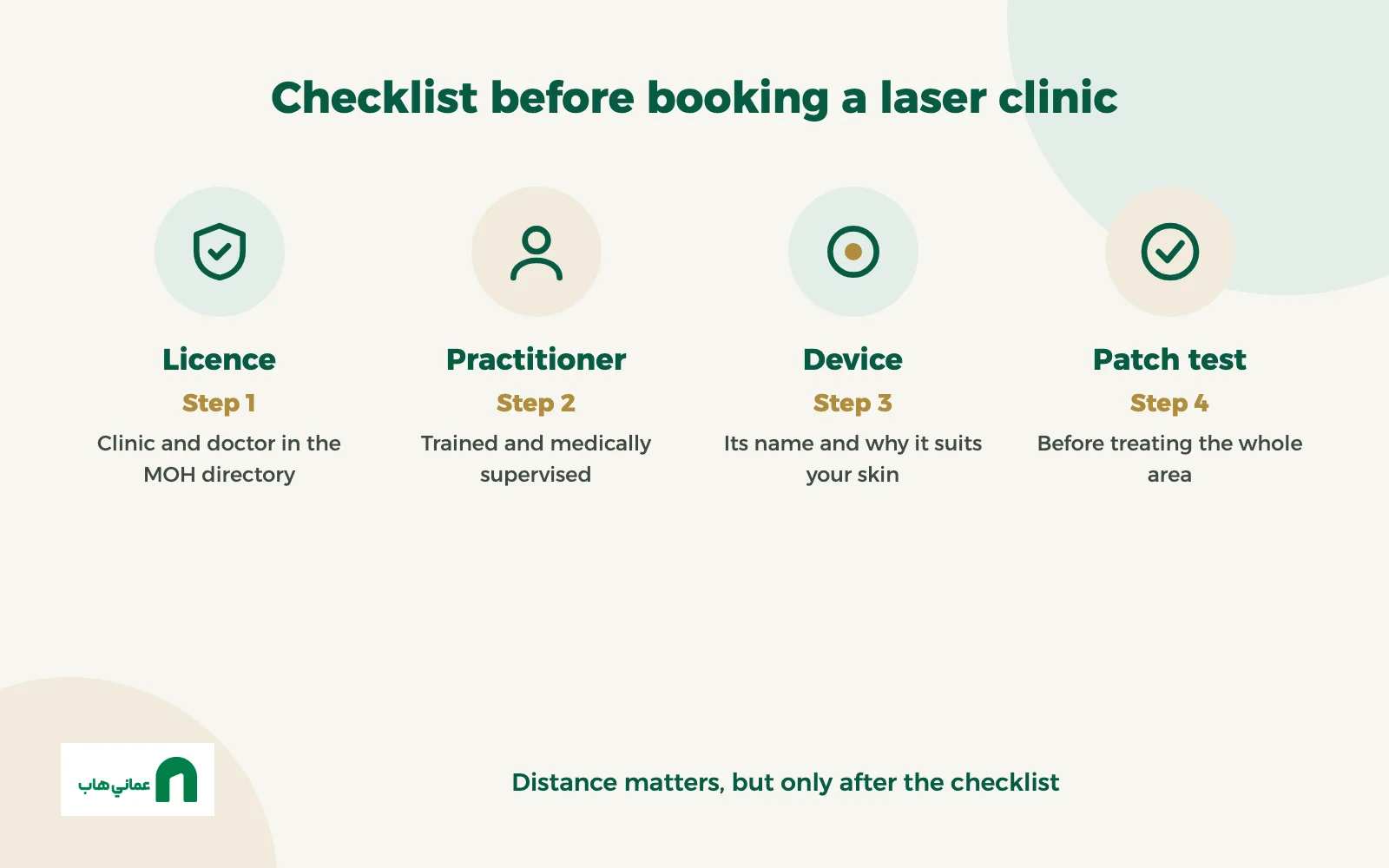
Short answer: When you search for a “laser clinic near me”, distance alone is not enough. Before you book, check four things: that the clinic and practitioner are licensed by Oman’s Ministry of Health, that the person operating the laser is trained and medically supervised, that the clinic can tell you which device it uses and why it suits your skin, and that it offers a consultation and a patch test before a full session. Then compare location, times and price.
Note: This guide is for general information and consultation preparation, not a diagnosis or treatment advice. OmaniHub is a directory for exploring providers; it does not provide treatment or decide whether a medical procedure suits you.
Searches such as “laser clinic near me” and “nearest laser clinic” are among the most common beauty searches in Muscat. That makes sense: laser hair removal takes several sessions spaced weeks apart, so distance and appointment times really matter. But a laser is a heat-based medical device, and with the wrong settings or untrained hands it can cause burns or permanent changes in skin colour.
This guide gives you a practical checklist to use before you book a first appointment at any laser clinic, near or far: how to check licensing, what to ask about the practitioner and the device, why a patch test matters, what safety signs to look for in the treatment room, when to postpone, and which warning signs to watch for in offers and adverts. If your question is which laser suits your skin tone, read Which laser suits your skin and hair colour?, and for the number of sessions, How many laser hair removal sessions do you need?
Quick links
- Why “nearest” should not be your only filter
- Step one: check the clinic’s and the practitioner’s licence
- Who will actually operate the laser?
- Ask about the device and how it is set for your skin
- The consultation and patch test before a full session
- Safety signs inside the laser room
- Who should talk to a doctor or postpone first?
- Before and after the session: your part
- Warning signs in offers and adverts
- How to use OmaniHub to compare
Why “nearest” should not be your only filter
Being close is a real advantage: you will visit many times, and each session needs to be booked at the right point in the hair growth cycle. But the American Academy of Dermatology (AAD) says plainly that laser hair removal can be dangerous in inexperienced hands, that burns, permanent changes to skin colour and scars can occur, and that the risk drops greatly when the treatment is performed by a medical doctor who is highly skilled with lasers and has in-depth knowledge of the skin.
Cleveland Clinic also says the procedure is usually safe and effective for most people, but that only an experienced healthcare provider should perform it. So the right question is not just “Where is the nearest clinic?” but “Which nearby clinic passes this checklist?” Start with the checklist, then pick the closest clinic among those that pass.
- Distance saves time, but it does not make up for missing licensing or training.
- Sessions repeat, so choosing the wrong clinic repeats the risk every time.
- Five minutes of questions before booking can save you a lot of worry later.
Step one: check the clinic’s and the practitioner’s licence
In Oman, the Ministry of Health, through its Directorate General of Private Health Establishments, licenses private health establishments and the healthcare professionals who work in them, and audits them. The Ministry says its online health portal includes open-data sections with a directory of licensed private health establishments and their specialties, licensed medical staff and their specialties, and a list of visiting doctors.
What you can do in practice:
- Ask for the clinic’s official name as it appears on its licence; it may differ from its Instagram name.
- Look the establishment up in the directory of licensed private health establishments on the Ministry of Health portal.
- Ask for the name of the doctor or practitioner who will supervise your treatment, and check their licence and specialty in the directory of licensed staff.
- If you are told a visiting doctor will treat you, ask when they are in Oman and who will follow up with you after they leave.
The Ministry also states that the directorate receives and investigates complaints against private health establishments and their staff. A regulator that knows the clinic is part of your protection if something goes wrong.
Who will actually operate the laser?
Many clinics have doctors, nurses and trained technicians working together. What matters is knowing who will hold the handpiece on your skin and who supervises them. The AAD recommends choosing a board-certified dermatologist for laser treatments and says rare side effects stay rare when treatment is performed by a dermatologist or under a dermatologist’s direct supervision.
The UK’s NHS advises booking a consultation with the person who will actually do the procedure before you decide, and asking them:
- How many of these procedures they have done.
- What qualifications and training they have, and whether they belong to a professional body that sets standards for training and skill.
- What the most common complications are, what aftercare you can expect and who will look after you.
- What happens if something goes wrong or you are not happy with the result.
- How much it will cost, and whether further sessions cost extra.
A clear, direct answer to these questions is a good sign. Evasion, or “Don’t worry, the machine is safe for everyone”, is worth pausing on.
Ask about the device and how it is set for your skin
Hair removal devices are not all the same. There are diode, alexandrite and Nd:YAG lasers and intense pulsed light (IPL) devices, and each has its own range. Cleveland Clinic explains that laser hair removal works best on thick, dark hair and light skin, because the contrast makes it easier for the hair to absorb heat, and that it may not work as well on dark skin or on blonde, grey, white or red hair.
So it is reasonable to ask:
- What is the device called and what type is it? Does it have more than one wavelength?
- Why did you choose this device for my skin tone and hair colour specifically?
- How do you set the parameters, and do you adjust them from session to session?
- Who services and calibrates the device, and when was it last serviced?
You do not need to understand every technical detail. Just notice whether the practitioner explains their choice clearly and links it to your skin, or repeats a generic advertising line. For the difference between device types in detail, see our guide to lasers by skin tone.
The consultation and patch test before a full session
A consultation is not a formality. The practitioner examines your skin and hair, asks about your health history and medicines, and explains what to expect. The NHS advises not paying for any procedure until you have had a consultation to make sure it is right for you, and says the practitioner should give you time to decide afterwards.
A patch test is a trial of the laser on a small area of skin before the whole area is treated. In the patient information from Leeds Teaching Hospitals NHS Trust, for example, a test patch is done before the first full treatment to assess how the skin reacts and whether treatment will work, photos of the area are taken to compare the response later, and the test is reviewed at the next appointment about six weeks later.
Timings vary between clinics, and some review a patch test after a few days. But the principle is the same: the whole area should not be treated with settings that have not first been tried on your skin, especially if your skin is tan or dark, or you have reacted to a cosmetic treatment before.
- Ask: Do you do a patch test, and how long do you wait before the full session?
- Ask: Do you photograph the area before starting so you can track results?
- If you are offered treatment of the full area on your first visit with no assessment at all, ask why.
Safety signs inside the laser room
The AAD describes treatment taking place in a room set up specifically for laser treatments, with everyone in the room wearing protective eyewear during the procedure. Cleveland Clinic says the provider gives you glasses or goggles and also wears eye protection. Leeds Teaching Hospitals notes that laser light is very bright and that, under laser safety rules, friends or relatives usually cannot accompany you into the treatment room.
| What you notice | Why it matters |
|---|---|
| A dedicated laser room with the door closed | Laser light is a risk to eyes; a dedicated room limits accidental exposure |
| Protective eyewear for you and the practitioner | Eye protection is required for everyone in the room |
| The area is cleaned before starting | Skin should be clean and free of make-up and creams |
| Questions about your health and medicines before each session | Some conditions and medicines change whether or how you are treated |
| An explanation of what you will feel and what comes after | Transparency is a sign of responsible practice |
These are general signs drawn from the sources listed, not an official inspection standard.
The AAD describes the sensation as warm pinpricks or a rubber band snapped against the skin, and you may smell a slight sulphur-like smoke from the hair. That is expected. Severe pain or a burning feeling that does not settle should be reported to the practitioner straight away.
Who should talk to a doctor or postpone first?
Cleveland Clinic says you should talk to your healthcare provider before laser hair removal, and that you may need to avoid it if you:
- Are pregnant.
- Take certain medicines, such as some acne treatments.
- Have genital herpes or are prone to cold sores.
- Have keloid (raised) scars.
- Have or have had skin cancer.
It adds that naturally or artificially tanned skin can make laser hair removal less effective and lead to side effects, so avoid tanning beds and the sun as much as possible in the weeks before treatment. Leeds Teaching Hospitals notes that some prescription medicines, such as those that make skin more sensitive to light, may mean you cannot be treated, so tell the clinic about everything you take in advance.
If excess hair growth is new, fast or comes with other symptoms, it may have a hormonal cause. Cleveland Clinic notes that excess hair can be linked to hormone imbalances or certain medicines; in that case seeing a doctor to find the cause comes before laser, not after.
Before and after the session: your part
Part of safety is in your hands. From the sources we reviewed:
- Shave the area two to three days before treatment (Cleveland Clinic), and avoid waxing, plucking and tweezing once treatment starts.
- Avoid tanning and direct sun before sessions, and use daily sunscreen on exposed areas.
- Keep the area free of make-up, moisturiser and sunscreen on the day (Leeds Teaching Hospitals).
- After the session, protect the skin from the sun, avoid tanning beds and follow the aftercare instructions (AAD).
The AAD says the common side effects are minor and last one to three days: discomfort, swelling and redness. Less common effects include blistering, cold sore flare-ups, infection, scarring, and lightening or darkening of the skin. Contact the clinic directly if you notice blisters, worsening pain, signs of infection or a clear change in skin colour.
Warning signs in offers and adverts
Offers are a normal part of the market, but some deserve caution. The NHS advises avoiding group treatments or events, treatment vouchers sold on group discount sites, mobile services that carry out procedures in homes or hotels, and practitioners who only advertise on social media.
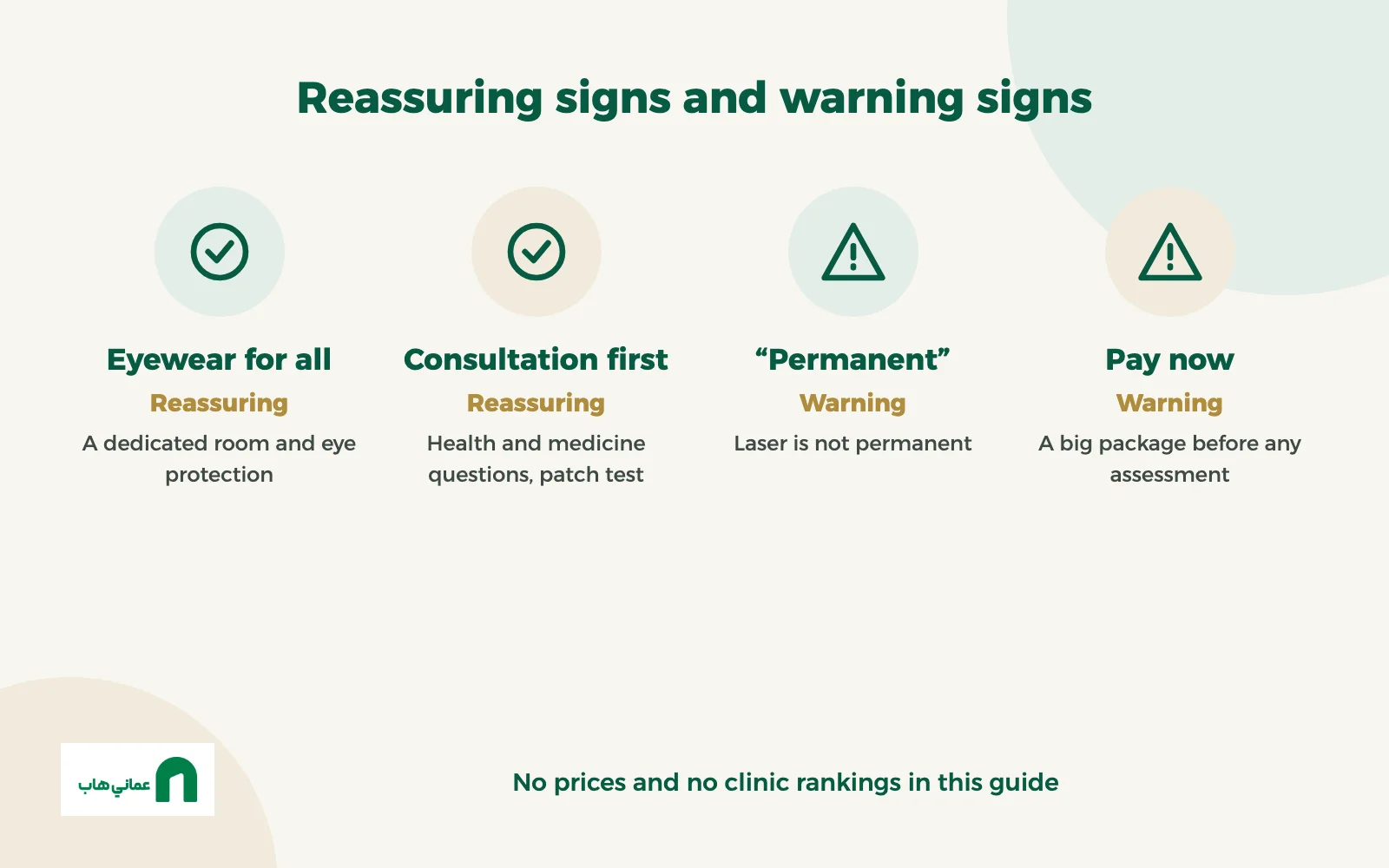
Other warning signs include:
- Promises of “permanent” removal or results “from the first session”. Cleveland Clinic says laser hair removal is not permanent, and most people see about a 10% to 25% reduction after the first treatment.
- Claims that one device “suits everyone with the same settings”.
- Pressure to pay for a large package immediately, before any consultation or patch test.
- No device name, practitioner name or supervising doctor mentioned.
- Sessions held somewhere that is not a dedicated treatment setting.
To compare packages fairly (area, number of sessions, what the price includes), read How to compare laser hair removal package costs in Muscat. This page lists no prices because each clinic sets its own.
How to use OmaniHub to compare
On the laser hair removal page for Muscat you will find listed clinics and centres with their locations and services. Use it as a starting point to shortlist two or three clinics near you, then run each one through the checklist in this guide: licence, practitioner, device, consultation and patch test, and the treatment room.
OmaniHub is a directory for exploring and comparing providers; it is not a licensing body and does not provide treatment. Official licence checks go through the Ministry of Health, and whether a treatment suits you is the doctor’s decision after an examination.
Frequently asked questions
How do I know a laser clinic is licensed in Oman?
Ask for the establishment’s official name and the supervising doctor’s name, then look both up in the directories of licensed private health establishments and licensed staff on the Ministry of Health portal.
Does a doctor have to perform the laser session personally?
Not necessarily at every clinic, but the AAD recommends treatment by a dermatologist or under a dermatologist’s direct supervision. Ask who will operate the device and who supervises them.
What is a patch test and is it necessary?
It is a trial of the laser on a small area to assess the skin’s reaction before the whole area is treated. Many clinics do it, including NHS hospital services, and it matters especially for dark or sensitive skin.
Is laser hair removal suitable for darker skin?
Most skin tones can be treated with the right device and settings by a trained practitioner, but the risk is higher when there is less contrast between hair and skin colour. Ask which device will be used and why.
What is normal after a session?
Redness, swelling and discomfort that usually last one to three days, according to the AAD. Blisters, worsening pain or a change in skin colour mean you should contact the clinic.
Is laser hair removal permanent?
No. Cleveland Clinic says it is not permanent, but results last longer than shaving or waxing, and you may need maintenance sessions.
Does OmaniHub recommend a specific laser clinic?
No. OmaniHub is a directory for comparing providers; it does not rank any clinic as the best or provide treatment.
Sources and review
- Oman Ministry of Health: Directorate General of Private Health Establishments (licensing, directory of licensed establishments and staff, complaints)
- American Academy of Dermatology (AAD): Laser hair removal FAQs
- Cleveland Clinic: Laser hair removal, who should avoid it, preparation and side effects
- NHS: Choosing who will do your cosmetic procedure
- Leeds Teaching Hospitals NHS Trust: Laser hair reduction patient information and test patch
Sources reviewed on 26 November 2026. Information is general and does not predict any individual case.