Laser Hair Removal: Which Type Suits Your Skin and Hair Colour?
A plain-language guide to diode, alexandrite and Nd:YAG lasers and how skin and hair colour affect safety and results.
Short answer: Laser hair removal works by targeting pigment (melanin) in the hair, so results and safety depend on the contrast between hair colour and skin colour, the type of laser and its settings. It can be used on most skin colours when performed by a trained practitioner, but risk is higher when contrast is low or skin is darker. The right device is decided at an examination, not by an advert.
Note: This guide is for general information and consultation preparation, not a diagnosis or treatment advice. OmaniHub is a directory for exploring providers; it does not provide treatment or decide whether a medical procedure suits you.
“Which laser suits my skin?” is one of the most common questions before a first session. Many people hear terms like diode, alexandrite and Nd:YAG without knowing the difference, and some adverts promise one result for everyone.
This guide explains in plain language how a laser interacts with hair colour and skin colour, what medical sources say about safety and choosing a practitioner, when laser may not be the right option, and how to prepare for a first consultation. If your question is about the number of sessions, read How many laser hair removal sessions do you need?
Quick links
- How does laser hair removal work?
- What decides whether laser suits you?
- Diode, alexandrite and Nd:YAG: the short difference
- Darker skin: what the sources say
- Before, during and after the session
- Results and sessions: realistic expectations
- Side effects and risks
- Who performs the session matters as much as the device
- Spacing between sessions and what happens in between
- Common mistakes and myths
- How to choose a centre in Muscat, step by step
- Questions to ask at the consultation
- Summary
How does laser hair removal work?
According to Mayo Clinic, laser hair removal uses a focused beam of light that targets the pigment in hair, called melanin. The light turns into heat that damages the hair follicles, which slows future hair growth. The American Academy of Dermatology (AAD) describes the hair as being vaporised, in a room set up for lasers where everyone wears protective eyewear.
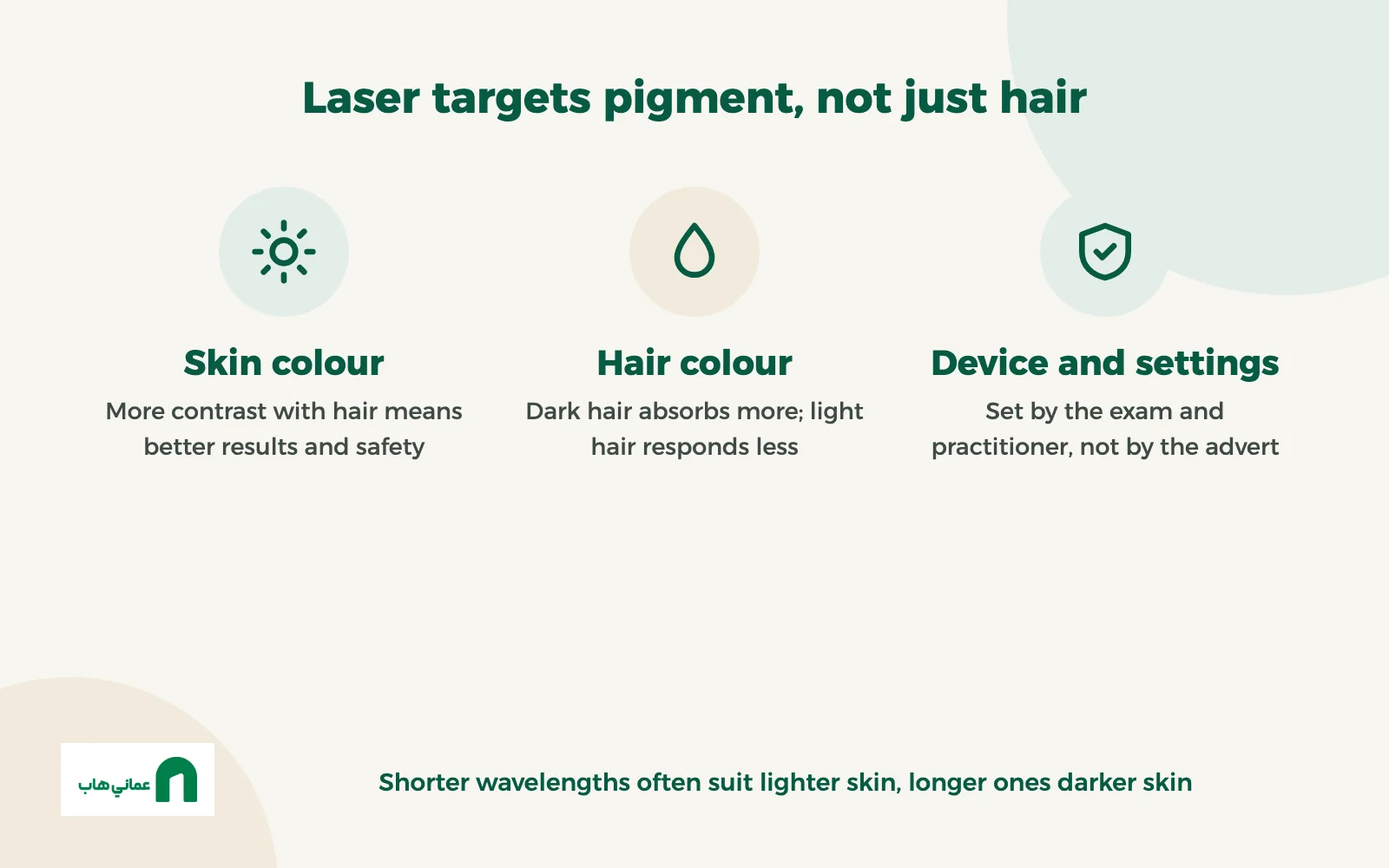
This is the key to everything that follows: the laser does not “see” hair, it is absorbed by pigment. Anything with pigment in the path of the light can absorb energy, including your own skin colour.
What decides whether laser suits you?
Medical sources list several factors that affect both results and safety:
- Hair colour: dark hair usually responds best because it carries more pigment. Mayo Clinic notes that blonde, white and grey hair have less pigment, so treatment is less effective, and it does not work as well on red hair.
- Skin colour: the AAD says laser works best on light skin with dark hair, but adds that advances mean it is now an option for people with light hair and light skin and for people with dark skin.
- Hair thickness and treated area: these affect the result and the number of sessions, along with the type of laser used.
- Health conditions: sometimes excess hair has a medical cause. Mayo Clinic explains that laser does not treat the cause, new hair may keep growing and ongoing treatment may be needed.
This is why good providers start with a consultation to review your medical history and medicines and to discuss risks and expected results.
Diode, alexandrite and Nd:YAG: the short difference
Devices are sold under technical names that differ in wavelength, the “colour” of light they emit. The general rule dermatologists explain: shorter wavelengths are absorbed more strongly by pigment and are usually a better match for light skin, while longer wavelengths are absorbed less by skin pigment and are often preferred for darker skin to reduce the chance of burns.
| Laser type | What is generally known | What the doctor decides |
|---|---|---|
| Alexandrite | Shorter wavelength; usually used on light skin with dark hair | Whether your skin, hair and the device settings suit it |
| Diode | Middle wavelength; common in clinics with a range of settings | Whether it suits your skin tone and is set to safe parameters |
| Nd:YAG | Longer wavelength; often used on darker skin | Whether your hair thickness and area suit it |
This table is for general understanding only, not treatment advice. Devices differ between manufacturers, and the settings and the practitioner’s experience matter as much as the laser type.
In short: there is no single “best laser for everyone”. What matters is that the device suits the contrast between your hair and skin and is set by a practitioner who knows your skin.
Darker skin: what the sources say
Mayo Clinic says laser hair removal can be used on people with black or brown skin when performed by an experienced healthcare professional. Darker skin contains more melanin, so choosing the right type of laser and settings is important to protect the skin while treating the hair effectively.
The risks are somewhat higher: treated skin may darken or lighten. These changes are usually temporary but can last in rare cases, and the risk is higher in people with black or brown skin and in those who do not avoid the sun before and after treatment. The AAD stresses that some colour changes can be permanent.
- Ask directly: have you treated skin like mine before?
- Ask which device you use and why you chose it for my skin.
- Ask for a small test area if the practitioner suggests one, and do not rush into treating a large area in the first session.
Avoid buying or using home devices without medical advice if your skin is dark; wrong settings are what cause burns and colour changes.
Before, during and after the session
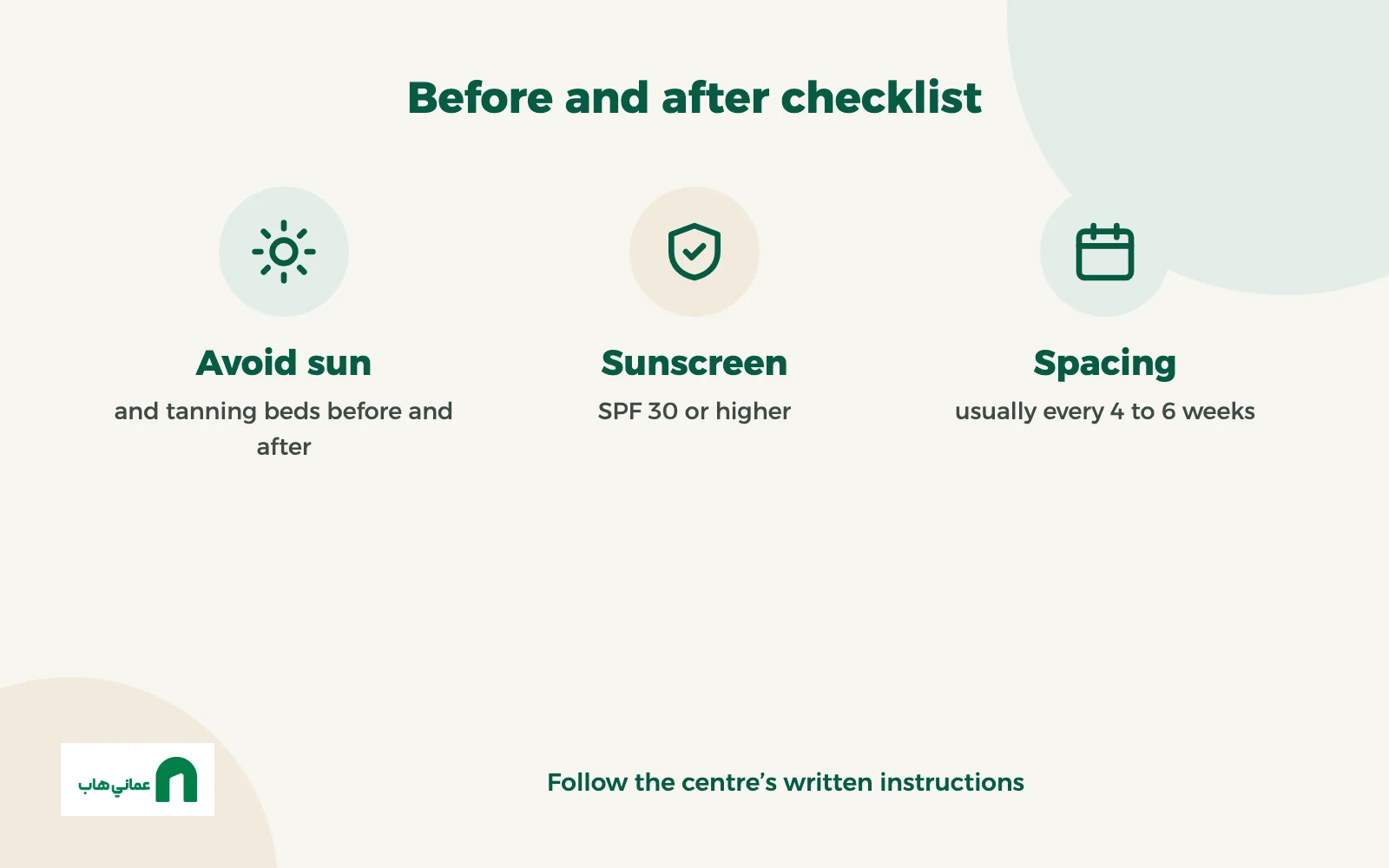
- Before: you are usually asked to avoid sun and tanning beds, use a broad-spectrum sunscreen of SPF 30 or higher, stop plucking, waxing and electrolysis at least four weeks before, and shave the area the day before, according to Mayo Clinic.
- During: the area is cleansed and a numbing gel may be applied. The AAD describes the feeling as warm pinpricks or a rubber band snapped against the skin, and everyone in the room must wear protective eyewear. Many devices have built-in cooling to protect the skin.
- Duration: an upper lip takes minutes, while a back or legs can take more than an hour.
- After: redness and swelling like a mild sunburn; a cool compress helps. There is usually no real downtime, but protect the skin from the sun consistently; Mayo Clinic advises six weeks or as your practitioner directs.
Follow the written instructions from your provider; according to the AAD, following before and after instructions greatly reduces the risk of side effects.
Results and sessions: realistic expectations
The AAD says results vary from person to person and that hair colour, thickness, area treated, type of laser and skin colour all affect them. It states most patients need 2 to 6 treatments, while Mayo Clinic says most people need 4 to 8 treatments for best results, usually scheduled several weeks apart.
The sources differ on the number, which is normal because it depends on your case. What matters is that this is a series of sessions, not one visit, and that laser greatly reduces hair growth but does not guarantee hair never grows back. When hair returns it is often finer and lighter, and maintenance sessions may be needed.
For more on session count and spacing, read How many laser hair removal sessions do you need?
Side effects and risks
Common effects are minor and usually last 1 to 3 days according to the AAD: discomfort, swelling and redness. Less common effects can occur:
- Blistering, crusting, scarring and changes in skin texture.
- Cold sore (herpes simplex) flare-ups and skin infection.
- Skin lightening or darkening; colour usually returns to normal over time, but some changes can be permanent.
- Rarely, hair can grow thicker in the area around the treated skin, per Mayo Clinic.
Laser is not recommended on the eyelids, eyebrows or surrounding areas because of the risk of serious eye injury, nor on tattooed skin. The AAD warns that laser hair removal can be dangerous in inexperienced hands, with burns, permanent colour changes and scars possible.
Who performs the session matters as much as the device
The AAD recommends a board-certified dermatologist, and Mayo Clinic advises a professional board certified in dermatology, cosmetic surgery or a related field, making sure whoever performs the procedure is properly trained or supervised, and being cautious about spas, salons or other places where non-medical staff perform it.
In Oman, private health establishments are regulated by the Ministry of Health; see the Directorate General of Private Health Establishments page to check a facility. Ask the centre about its licence and the staff’s training on the specific device.
You can compare listed centres and reviews on the laser hair removal page for Muscat. If you are comparing packages, how to compare costs in packages may help. This page lists no prices because each centre sets its own.
Spacing between sessions and what happens in between
According to the AAD, most people can have a session about every 4 to 6 weeks, and your doctor decides when the next one is safe. You may notice results straight away; the AAD expects roughly a 10% to 25% reduction in hair after the first session, varying from person to person.
Why several sessions? Hair grows in phases, so not every hair is at the same stage on the day. Each session treats what it can reach and later sessions deal with what appears afterwards. Shorter gaps do not mean faster results and may raise the risk of irritation.
Between sessions keep protecting the skin from the sun, follow the centre’s advice on shaving and moisturising, and tell the practitioner about any new medicine or change in your skin.
Common mistakes and myths
- “One laser suits everyone”: devices and settings differ; what works for light skin and dark hair may not suit darker skin.
- “One session is enough”: medical sources describe a series of sessions.
- “Cheapest is best”: price is not a safety measure; qualifications, experience and a device suited to your skin matter most.
- “Sun protection doesn’t matter”: protecting skin before and after treatment lowers the risk of colour change, according to the AAD and Mayo Clinic.
- “I can try a home device on dark skin without advice”: wrong settings are what cause burns and colour change; ask a doctor first.
If you are unsure whether laser suits you, the first consultation is the place to ask, and you are free to leave without booking a package.
How to choose a centre in Muscat, step by step
- 1. Check the licence: ask the centre and review the Ministry of Health private establishments page.
- 2. Know who performs the session: ask for the practitioner’s name, qualifications and training on the device.
- 3. Book a consultation first: skin, hair and health history come before any promise of results.
- 4. Compare devices by fit for your skin, not by brand names alone.
- 5. Read the package terms: number of sessions, maintenance sessions and what happens if you must reschedule.
- 6. Ask for written before- and after-care instructions.
OmaniHub helps you gather centres in one place and compare them with the same questions. Open the list of laser hair removal centres in Muscat and ask each one about the points above.
Questions to ask at the consultation
- Which laser do you suggest for my hair and skin colour, and why?
- Have you treated skin like mine, and what do you change in the settings?
- Do I need a small test patch before full treatment?
- How many sessions should I expect, how far apart, and does the package include maintenance sessions?
- Who will perform the session and what are their qualifications?
- Which medicines or health conditions could affect treatment, and what should I avoid before and after?
- What should I do if I get burns, blisters or a colour change?
Summary
Choosing the right laser starts with understanding that it targets pigment: hair colour, skin colour and the contrast between them come first, then the device type, the settings and the practitioner’s experience. Most skin colours can be treated according to the sources, but risk rises with darker skin and lower contrast, so do not rely on an advert or a device name.
Take your time at the consultation, ask the questions above, protect your skin from the sun before and after sessions, and do not compare centres on price alone.
Frequently asked questions
Does laser hair removal suit every skin colour?
Mayo Clinic says it can be used on people with black or brown skin when performed by an experienced professional, but the risk is higher and the right device and settings are essential.
Does laser work on white or blonde hair?
It is less effective because this hair carries less pigment, according to Mayo Clinic. It also does not work as well on red hair.
Is laser hair removal permanent?
It greatly reduces hair growth but does not guarantee hair never returns. Many people stay hair-free for months or years, and maintenance sessions may be needed.
Does it hurt?
Many people describe warm pinpricks or a rubber band snapping on the skin; numbing gel and cooling can help.
Is there downtime?
There is usually no real downtime, but redness and swelling appear and you must protect the skin from the sun.
Can I use a home laser device instead of a centre?
This guide does not cover home devices, but the sources stress correct settings and experience. Ask a doctor before using any device, especially on darker skin.
Does OmaniHub recommend a specific centre?
No. OmaniHub is a directory for comparing providers; it does not provide treatment or rank any centre as the best.
Sources and review
- AAD: Laser hair removal FAQs
- Mayo Clinic: Laser hair removal
- Oman Ministry of Health: private health establishments
Sources reviewed on 23 November 2026. Information is general and does not predict any individual case.