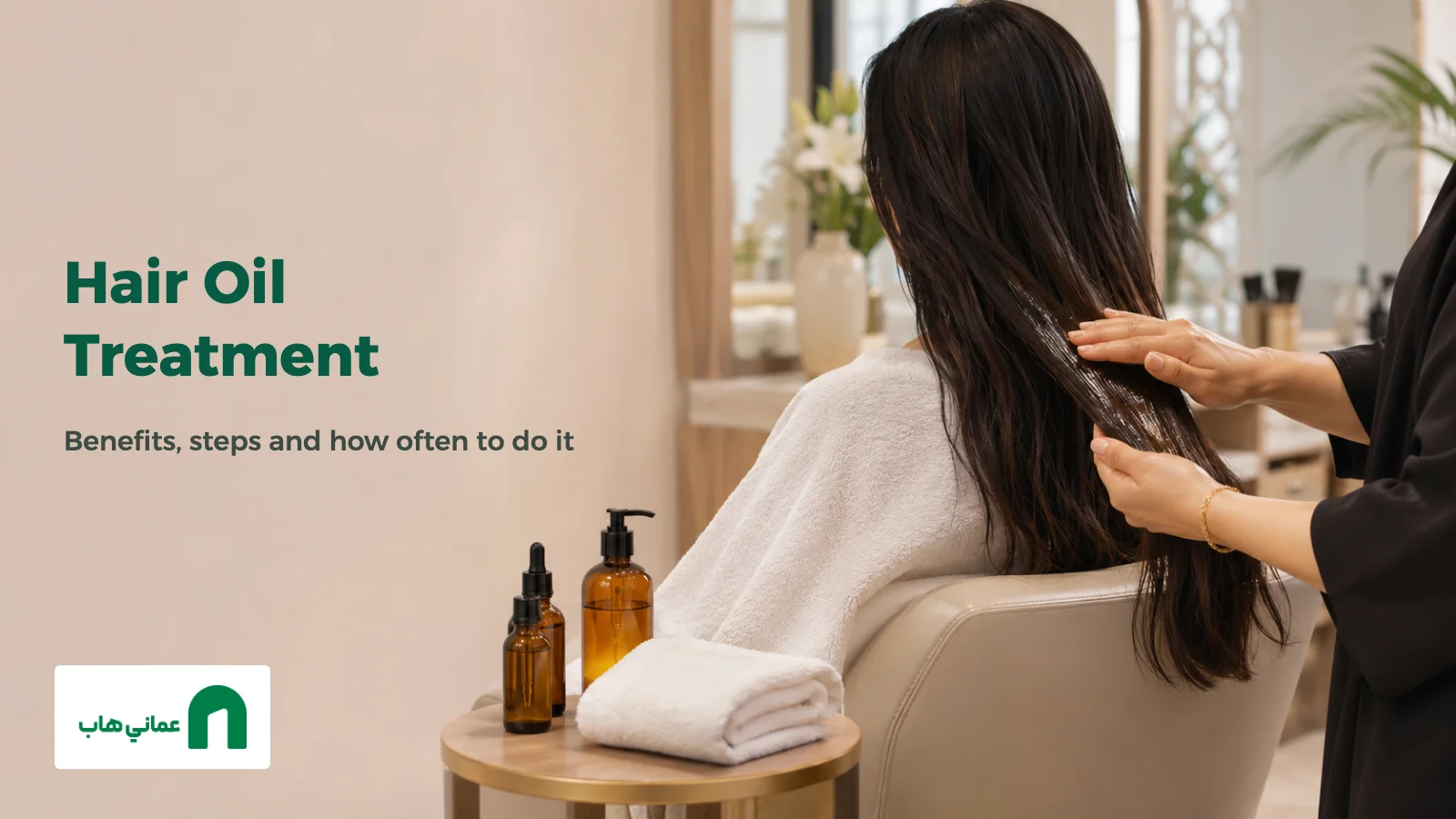
Hair Oil Treatment: Benefits, Steps and How Often to Do It
What a hair oil treatment really does, who it suits, which oil to choose, how to do it at home, how often, and when to keep oil off your scalp.
Short answer: A hair oil treatment means applying a small amount of natural oil to the lengths and ends of your hair, leaving it for 20 minutes to an hour, then washing it out. It usually helps dry, coarse and curly hair most, adding moisture and shine, and coconut oil may reduce protein loss from the hair. A safe start is once a week on the ends, and keeping oil off your scalp if you have dandruff.
Note: This guide is for general information and consultation preparation, not a diagnosis or treatment advice. OmaniHub is a directory for exploring providers; it does not provide treatment or decide whether a medical procedure suits you.
The hair oil bath is one of the oldest hair care habits in Oman and the Gulf, and it is still a service many women book at salons, especially with the heat, the sun and frequent blow-drying and straightening. But the internet is full of big promises about hair oiling: longer hair, less hair fall, no more dandruff. What does the evidence actually support, and what is just habit or marketing?
This guide explains what a hair oil treatment is, its real benefits according to medical sources, who it suits and who it does not, which oil to choose, how to do it at home, how often to do it, when a salon is a good option and which questions to ask before booking. If you are looking for a salon, you can compare listed salons on the hair oil treatment page for Muscat.
Quick links
- What is a hair oil treatment?
- What does the evidence say about the benefits?
- Who does a hair oil treatment suit?
- Which oil should you choose?
- How to do a hair oil treatment at home
- How often should you do it?
- Scalp and dandruff: when to avoid oil
- Salon hair oil treatment: what to ask before booking
- Common hair oiling mistakes
What is a hair oil treatment?
Hair oiling is an old practice with roots in traditional Indian medicine (Ayurveda) that spread across the region and the world as part of natural hair care. The idea is simple: spread a natural oil through your hair, sometimes massage it in, leave it for a while, then wash it out.
Cleveland Clinic explains that there are two common methods: one applies oil to the scalp and massages it, while the other applies it only to the lengths and ends of the hair to keep them hydrated and hide split ends. The difference matters, because putting oil on your scalp does not suit everyone, as explained below.
At a salon, the service may be called a hair oil bath, hot oil treatment or part of a hair treatment session, and some salons use gentle heat such as a warm towel or a steamer. Details differ from salon to salon, so ask about the steps before you book.
What does the evidence say about the benefits?
Like skin, hair needs a balance of oils to stay soft and strong. Frequent washing, heat and colour remove part of that balance, and a hair oil treatment tries to restore it. Here are the main benefits and what supports them:
| Benefit | What the sources say |
|---|---|
| Moisture and shine | Cleveland Clinic notes that oils add moisture and shine, especially to hair affected by heat and styling. |
| Less protein loss | A 2003 study by Rele and Mohile found that coconut oil was the only one of three oils to reduce protein loss in both undamaged and damaged hair. |
| Less breakage | A 2015 scientific review notes that regular oil use can improve lubrication of the hair shaft and help prevent breakage. |
| Look of split ends | Oil improves how split ends look only temporarily; it does not repair them. A trim is the fix. |
| Longer hair or less hair fall | The sources we reviewed do not show enough evidence for this; hair loss has medical causes that need assessment. |
This table summarises the sources listed at the end of the article; it is not a promise of results for every person.
The bottom line: a hair oil treatment is cosmetic care for the hair strand itself. It improves feel and appearance and offers some protection, but it is not a treatment for hair loss or scalp conditions. If your hair is falling out heavily, see a dermatologist; you can also read the hair loss treatment page.
Who does a hair oil treatment suit?
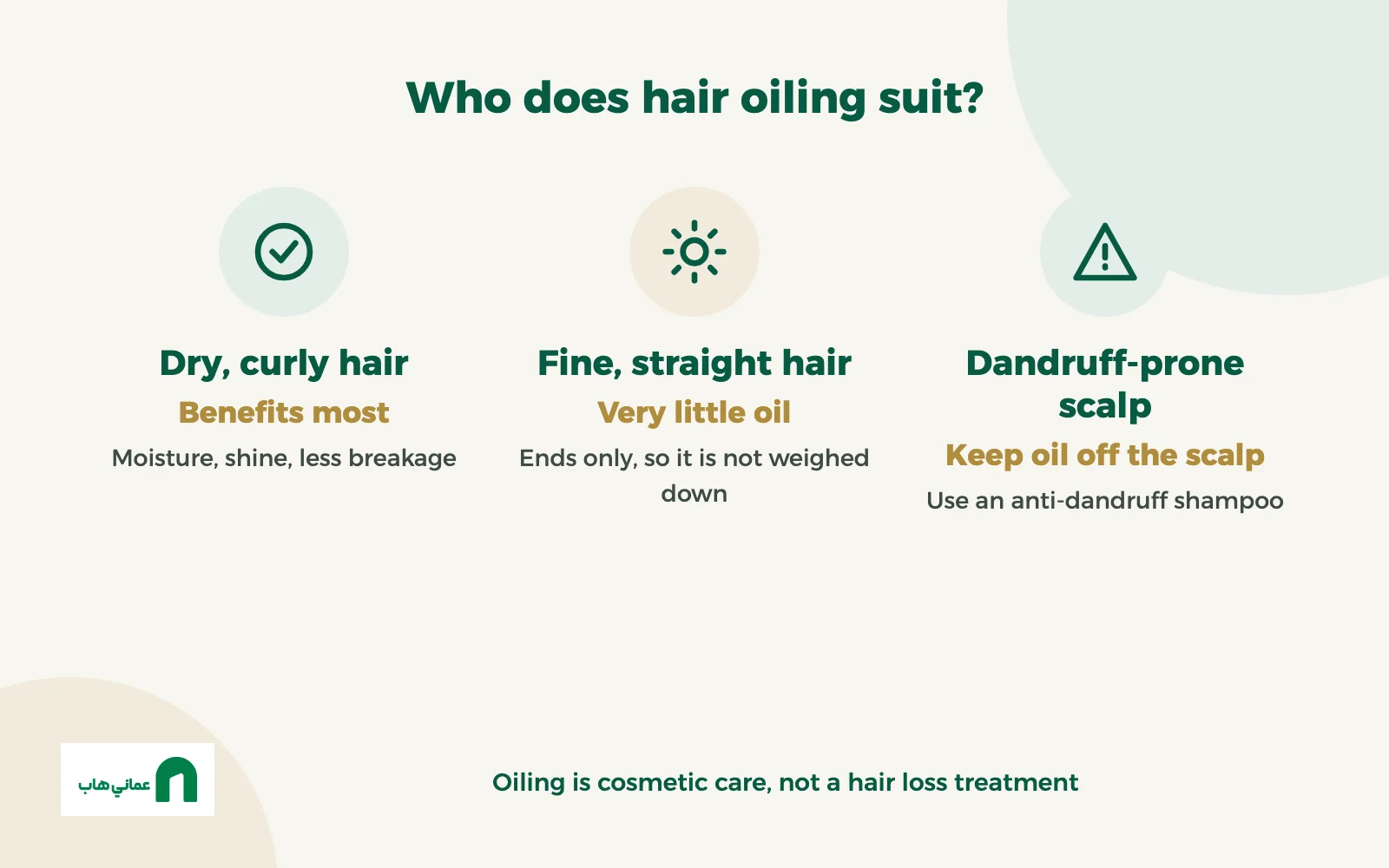
There is no single routine for every hair type. Dermatologist Shilpi Khetarpal, MD, of Cleveland Clinic says some hair types benefit from oiling more than others:
- Dry, coarse, tightly curled hair: usually benefits the most.
- Fine, straight hair: oil can weigh it down; if you try it, use a very small amount on the ends only.
- Dandruff-prone scalps: she advises avoiding oils, because oil on the scalp may raise the risk of seborrheic dermatitis, a form of dandruff.
- Coloured or heat-styled hair: can benefit from the extra moisture, with the right amount and oil.
The sources list other factors that change the result: how dry or oily your hair naturally is, any medical conditions, previous colouring or styling, and age.
Which oil should you choose?
Cleveland Clinic recommends natural oils where possible to avoid additives that may irritate the hair, and lists argan, coconut, sesame and almond oil. Research gives a clearer picture of some of them:
| Oil | What we know |
|---|---|
| Coconut oil | Penetrates the hair shaft thanks to its small, straight molecules, and reduced protein loss before and after washing in the 2003 study. |
| Sunflower oil | Did not reduce protein loss in the same study; it penetrates the hair only to a limited extent. |
| Mineral oil | Does not penetrate the hair and did not reduce protein loss, though it coats the surface. |
| Almond oil | Research cited by Cleveland Clinic suggests it may form a barrier that helps protect hair from the sun. |
| Argan and sesame oil | Common natural oils for moisturising the lengths and ends. |
Results vary with hair type. If you are allergic to any ingredient, avoid it and ask the salon about ingredients.
Note that “natural” does not mean “right for everyone”. Some scented oils or ready-made blends contain additives that can irritate a sensitive scalp. When trying a new oil, start with a small amount on the ends and watch how your hair responds.
How to do a hair oil treatment at home
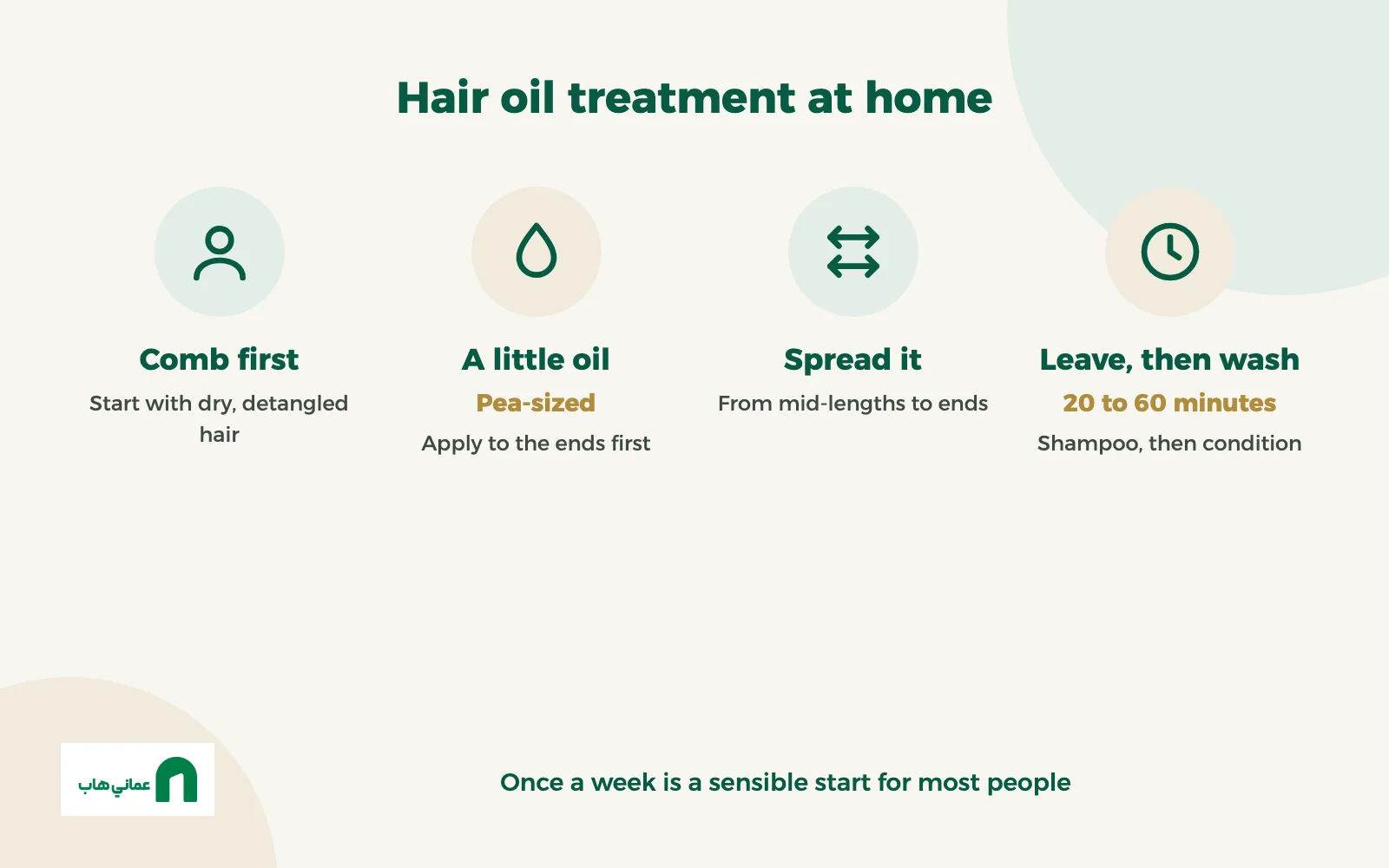
Dr. Khetarpal says oil can be applied to the ends of the hair and washed out after several hours, and that it is best applied to dry hair in a small amount. This is the weekly method Cleveland Clinic suggests:
- Brush or comb your hair first to avoid tangles.
- Put a pea-sized amount of oil in your hand. A little goes a long way.
- Apply it to the ends first.
- Spread it with your fingers evenly from the middle of your hair to the ends.
- Leave it on as long as you like, from 20 minutes to an hour.
- Wash it out with shampoo, focusing the shampoo on your scalp as the American Academy of Dermatology advises, then use conditioner.
If you like to warm the oil, make it warm, not hot, and test the temperature on the back of your hand first to avoid burns. After washing, be gentle with wet hair: use a wide-tooth comb and wrap your hair in a towel or cotton T-shirt instead of rubbing it, as the AAD recommends.
How often should you do it?
There is no single number for everyone, but the sources give a clear starting point:
- Once a week is the routine Cleveland Clinic suggests, and a sensible start for most people.
- Very dry or curly hair may tolerate oil more often, but start slowly and watch your hair.
- Fine or oily hair may need less, or just a tiny amount on the ends.
Remember that more oil means more washing to remove it, and frequent washing can dry hair. The AAD advises washing based on how dirty or oily your hair gets: daily for straight hair with an oily scalp, and as needed for dry, curly or thick hair, at least once every 2 to 3 weeks. Match your oil routine to the wash routine that suits your hair.
The most important rule: start slowly. Every head of hair is different, and even natural oils give different results from person to person.
Scalp and dandruff: when to avoid oil
This is where opinions differ. Some studies suggest coconut oil may benefit the scalp, but dermatologists such as Dr. Khetarpal advise against putting oil directly on the scalp, because it may raise the risk of seborrheic dermatitis, or dandruff. That is why Cleveland Clinic concludes it is generally best to avoid oiling the scalp.
The NHS explains that dandruff is common, not harmful and not contagious, and that treatment usually starts with an anti-dandruff shampoo containing an ingredient such as ketoconazole, coal tar or salicylic acid, used for up to 4 weeks. See a doctor if:
- dandruff continues after at least 4 weeks of anti-dandruff shampoo;
- the dandruff is bad or your scalp is very itchy;
- your scalp is red or swollen;
- you have flaky, itchy patches on your face or other parts of your body.
If you have dandruff, do not rely on a hair oil treatment to fix it. Put oil on the lengths and ends only if you want, or skip it until your scalp improves.
Salon hair oil treatment: what to ask before booking
Many women choose a salon hair oil treatment because it is relaxing and usually includes a massage, wash and blow-dry. Services vary between salons, so it helps to ask before booking:
- Which oil or product do you use, and can I see the ingredients?
- Is the oil applied to the scalp or only to the lengths? (important if you have dandruff)
- Do you use heat or steam, and how long is the session?
- Does the price include washing, drying and styling?
- Can I bring my own oil if I am allergic to certain ingredients?
If your hair is badly damaged from colour or straightening, the salon may suggest a different treatment such as protein or keratin instead of, or alongside, an oil treatment. You can read about damaged hair treatment and hair protein and keratin before you decide.
To compare listed salons, reviews and locations, browse the hair oil treatment page for Oman. We list no prices here because each salon sets its own.
Common hair oiling mistakes
- Using too much: it weighs hair down and needs repeated washing to remove. A little is enough.
- Oiling a dandruff-prone scalp: it may make the problem worse instead of better.
- Overheating the oil: very hot oil can burn the scalp. Warm only.
- Expecting medical results: oiling has not been shown to stop hair fall or make hair grow longer.
- Using heat tools straight after without protection: the AAD advises limiting blow-dryers and irons, using low or medium heat and a heat-protection product.
- Ignoring your hair type: what suits dry curly hair may not suit fine oily hair.
Avoid these mistakes and a hair oil treatment becomes a simple, safe habit for most people, adding moisture and shine without trouble.
Frequently asked questions
What are the benefits of a hair oil treatment?
It adds moisture and shine, temporarily improves how split ends look, and coconut oil may reduce protein loss from the hair according to a 2003 study.
How often should I oil my hair each week?
Once a week is a sensible start for most people; then adjust to your hair type and how it responds.
How long should I leave oil in my hair?
Cleveland Clinic suggests 20 minutes to an hour before washing. Some people leave it on the ends for several hours.
Should I put oil on my scalp?
Dermatologists advise against it, especially if you have dandruff, because it may raise the risk of seborrheic dermatitis.
Which oil is best for hair?
Coconut oil has been shown in research to reduce protein loss. Argan, almond and sesame are other common natural options. The best fit depends on your hair.
Does hair oiling stop hair loss?
The sources we reviewed do not show enough evidence for that. Heavy hair fall needs assessment by a dermatologist.
Does OmaniHub recommend a specific salon?
No. OmaniHub is a directory for comparing salons and providers; it does not provide the service or rank any salon as the best.
Sources and review
- Cleveland Clinic: Hair oiling, should you try it?
- Rele and Mohile (2003): Effect of mineral oil, sunflower oil and coconut oil on prevention of hair damage, Journal of Cosmetic Science
- Gavazzoni Dias (2015): Hair cosmetics, an overview
- American Academy of Dermatology (AAD): Tips for healthy hair
- NHS: Dandruff
Sources reviewed on 20 November 2026. Information is general and does not predict any individual case.