

Botox vs filler: how each works and which one suits you
Botox relaxes muscles while filler restores volume. A full guide to how they differ in use, duration, risks and pricing, and when doctors combine them.
Short answer: Botox relaxes the muscles behind lines that appear with movement, while filler adds volume or fills lines and hollows in specific areas. Botox usually lasts 3 to 4 months; filler lasts from several months to a year or more depending on the type. Which one suits you is decided by an examination, not an advert or a photo.
Note: This guide is for general information and consultation preparation, not a diagnosis or treatment advice. OmaniHub is a directory for exploring providers; it does not provide treatment or decide whether a medical procedure suits you.
“Botox or filler?” is a very common question, because both are injected into the face and are often advertised together. In reality they work in completely different ways, treat different concerns and carry different risks.
This guide explains the difference in practical terms: how each works, which concern it treats, how long it lasts, its side effects, when doctors combine them and how to read a price quote.
Quick links
- How does each one work?
- Which concern does each one treat?
- How long does each one last?
- Side effects and risks
- Can they be combined?
- How to read a price quote
- Key questions before you decide
How does each one work?
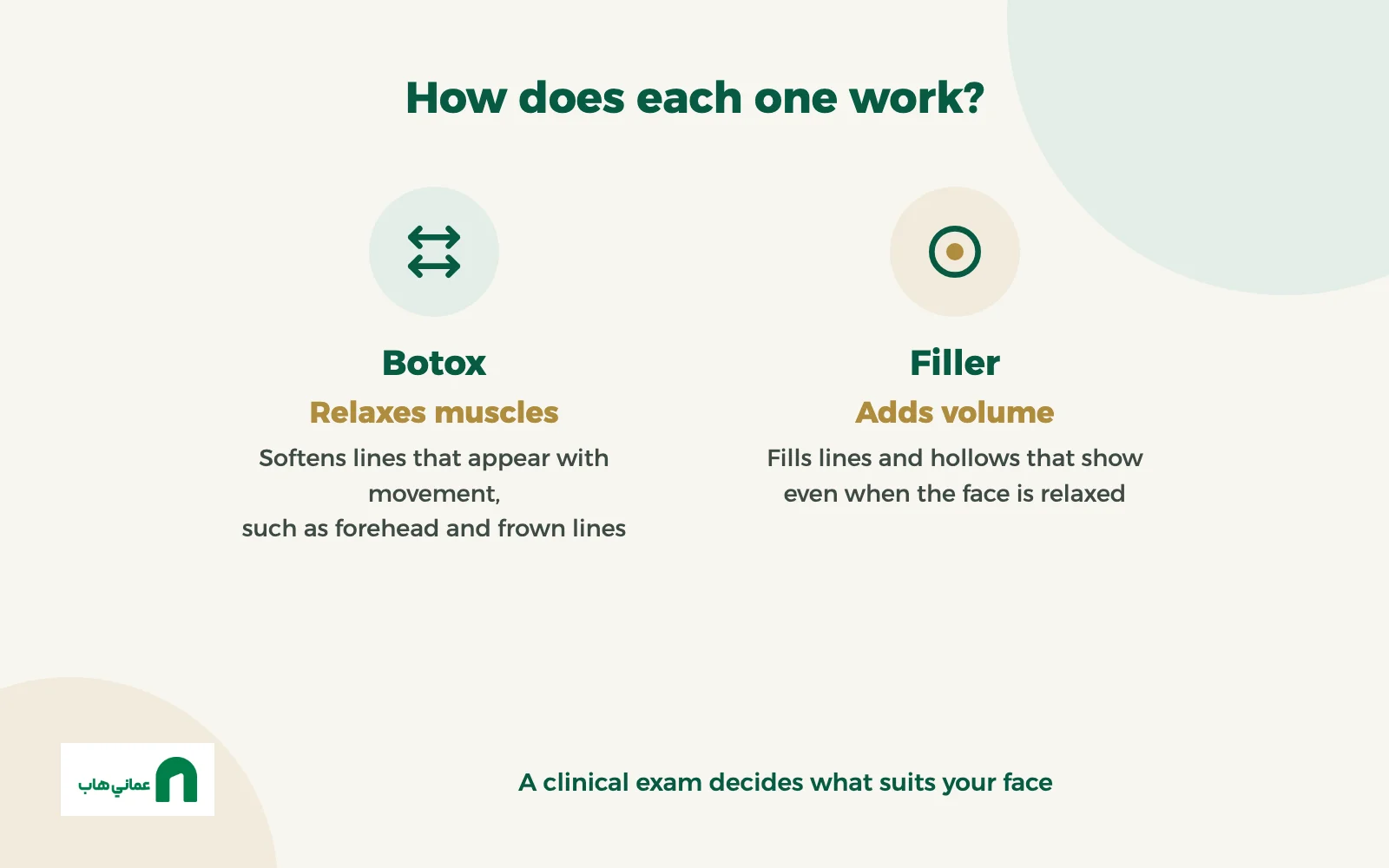
Botox is a well-known brand name for botulinum toxin products. It is injected into specific muscles and weakens the nerve signal that makes them contract, softening lines that form with movement. It does not add volume or fill anything.
Filler is a substance injected under the skin to restore volume or fill a line or hollow. The best-known type is hyaluronic acid, and other types differ in how long they last and how they work. Filler does not relax muscles.
Which concern does each one treat?
A simple rule helps: look at your face while it moves, then while it is relaxed.
- Lines that appear with movement and fade at rest, such as forehead lines, frown lines and crow’s feet when smiling, are usually Botox territory.
- Lines or hollows that show even at rest, or volume loss in the cheeks, lips, under the eyes or around the mouth, are usually filler territory.
- Mixed cases: many faces have both, and the doctor may suggest a combined plan or other alternatives.
This rule is only for understanding, not a diagnosis. Some concerns are treated by neither, such as clear skin laxity or pigmentation, which need other solutions.
How long does each one last?
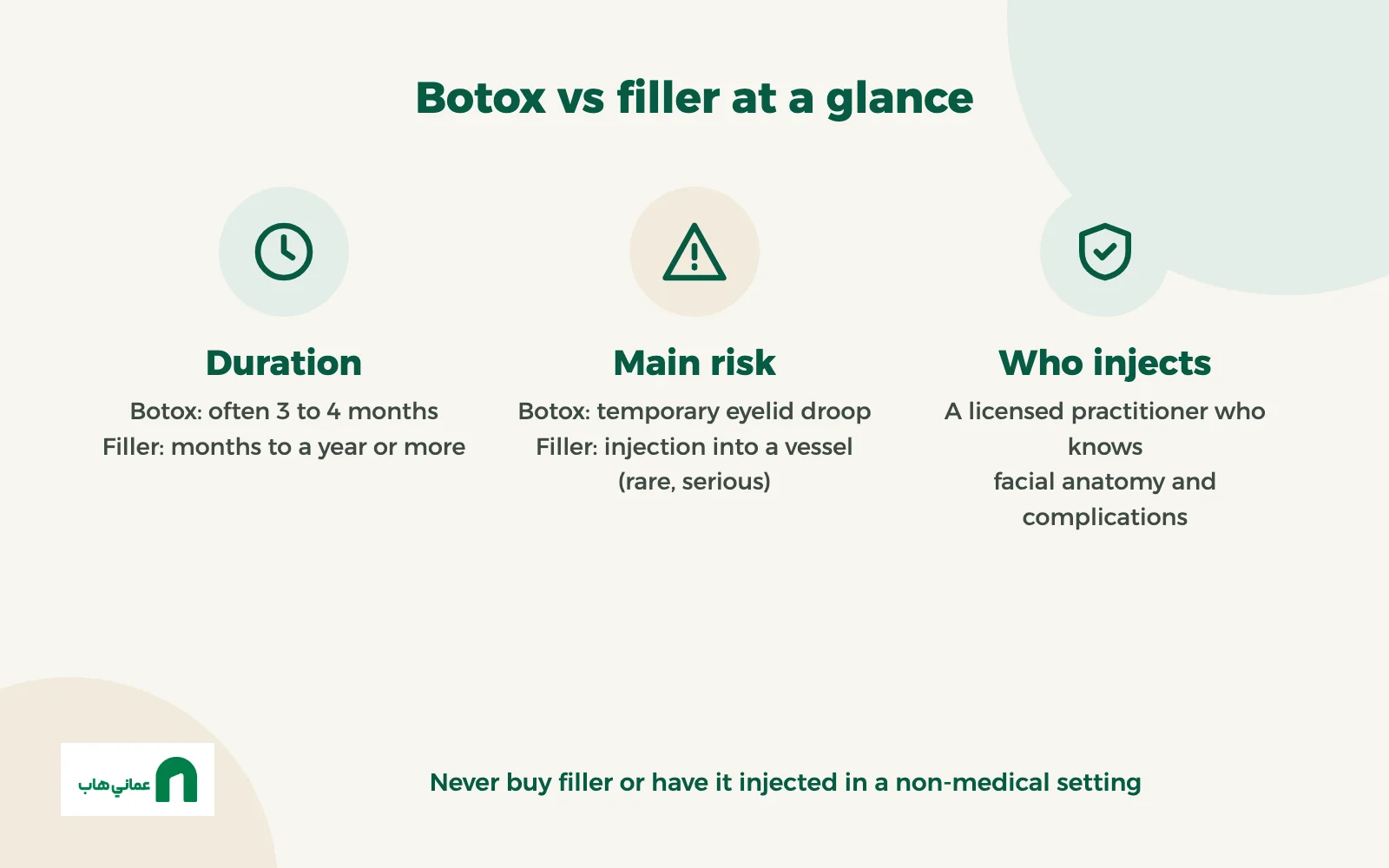
According to the American Academy of Dermatology (AAD), botulinum toxin for wrinkles usually lasts about 3 to 4 months. Filler duration depends on the type:
| Type | Typical duration (AAD) |
|---|---|
| Hyaluronic acid | 4 to 12 months |
| Calcium hydroxylapatite | 6 months to 1 year |
| Poly-L-lactic acid | 1 to 3 years |
| Fat from your body | 1 to 3 years |
| Botox (for comparison) | Often 3 to 4 months |
Duration varies with the area, amount and person. Ask your doctor how long the suggested product should last in your area.
For more on how long Botox lasts and what affects it, read How long does Botox last?
Side effects and risks
Both can cause common temporary effects such as redness, swelling and mild bruising at the injection site. Each also has its own risks:
- Botox: a temporary drooping eyelid or brow, or uneven movement, can happen if the product spreads to a nearby muscle. These effects are usually temporary.
- Filler: the US Food and Drug Administration (FDA) warns of a rare but serious risk of filler being injected into a blood vessel, which can damage skin or affect vision. That is why it should be injected by a qualified practitioner who knows facial anatomy and can manage complications immediately.
The FDA also advises never buying filler or injecting it yourself, and never having injections in non-medical settings. Seek care right away if you notice severe pain, a clear change in skin colour or any change in vision after filler.
Can they be combined?
Yes. Many doctors combine Botox and filler in one plan, because a face may need some muscles relaxed and volume restored elsewhere. For example: Botox for forehead lines and filler for volume loss in the cheeks.
This may happen in one session or in stages, depending on the doctor’s assessment. What matters is that the plan is based on an examination of your face and your priorities, not a ready-made package.
How to read a price quote
The two are priced differently, which often causes confusion:
- Botox is usually priced by area or number of units.
- Filler is usually priced per syringe and by product type.
- Always ask for the product name, the amount, and whether a review or touch-up is included.
The lowest price is not necessarily the best, and a quote that does not name the product or the injector deserves extra questions. This page lists no prices because each clinic sets its own.
Key questions before you decide
- What concern do you see, and why do you suggest this treatment specifically?
- Is Botox, filler or a combination right for me, and what are the alternatives?
- Which product and how much, and how long should the result last?
- What are the risks in the suggested area, and how do you handle complications?
- Who will inject me, and what is their licence and experience?
You can compare listed clinics and reviews on the Botox and filler page for Muscat, and check licensing through Oman’s Ministry of Health.
Related pages: Botox and fillers in Oman, Botox Muscat and fillers Muscat: listed clinics.
Frequently asked questions
Are Botox and filler the same thing?
No. Botox relaxes muscles, while filler adds volume or fills lines.
Which is better for forehead lines?
Forehead lines that appear with movement are usually treated with Botox; the doctor decides after an examination.
Which lasts longer?
Filler usually lasts longer, from several months to a year or more depending on type, while Botox often lasts 3 to 4 months.
Is filler riskier than Botox?
Each has its own risks. Filler carries a rare but serious risk of injection into a blood vessel, so the practitioner’s experience matters a lot.
Can filler be dissolved?
Some hyaluronic acid fillers can be dissolved with a special enzyme at the doctor’s discretion; this does not apply to every type.
Do I need both?
Not necessarily. Some people need only one, and some need neither.
Does OmaniHub recommend a specific clinic?
No. OmaniHub is a directory for comparing providers; it does not provide treatment or rank any clinic as the best.
Sources and review
- FDA: Dermal filler do’s and don’ts
- FDA: Dermal fillers and their risks
- AAD: Filler FAQs and how long each type lasts
- AAD: Botulinum toxin FAQs
- Oman Ministry of Health: private health establishments
Sources reviewed on 15 November 2026. Information is general and does not predict any individual case.